

For years, ecologists held a basic assumption about nature: if multiple giant predators share the same territory, they will naturally avoid one another. If you’re a snow leopard, you might stay high up the cliffs; if you’re a common leopard, you stay low in the forest. If one hunts by day, the other hunts by night.
But a groundbreaking new study published in PLOS ONE and featured by Mongabay turned this rule of thumb completely on its head.
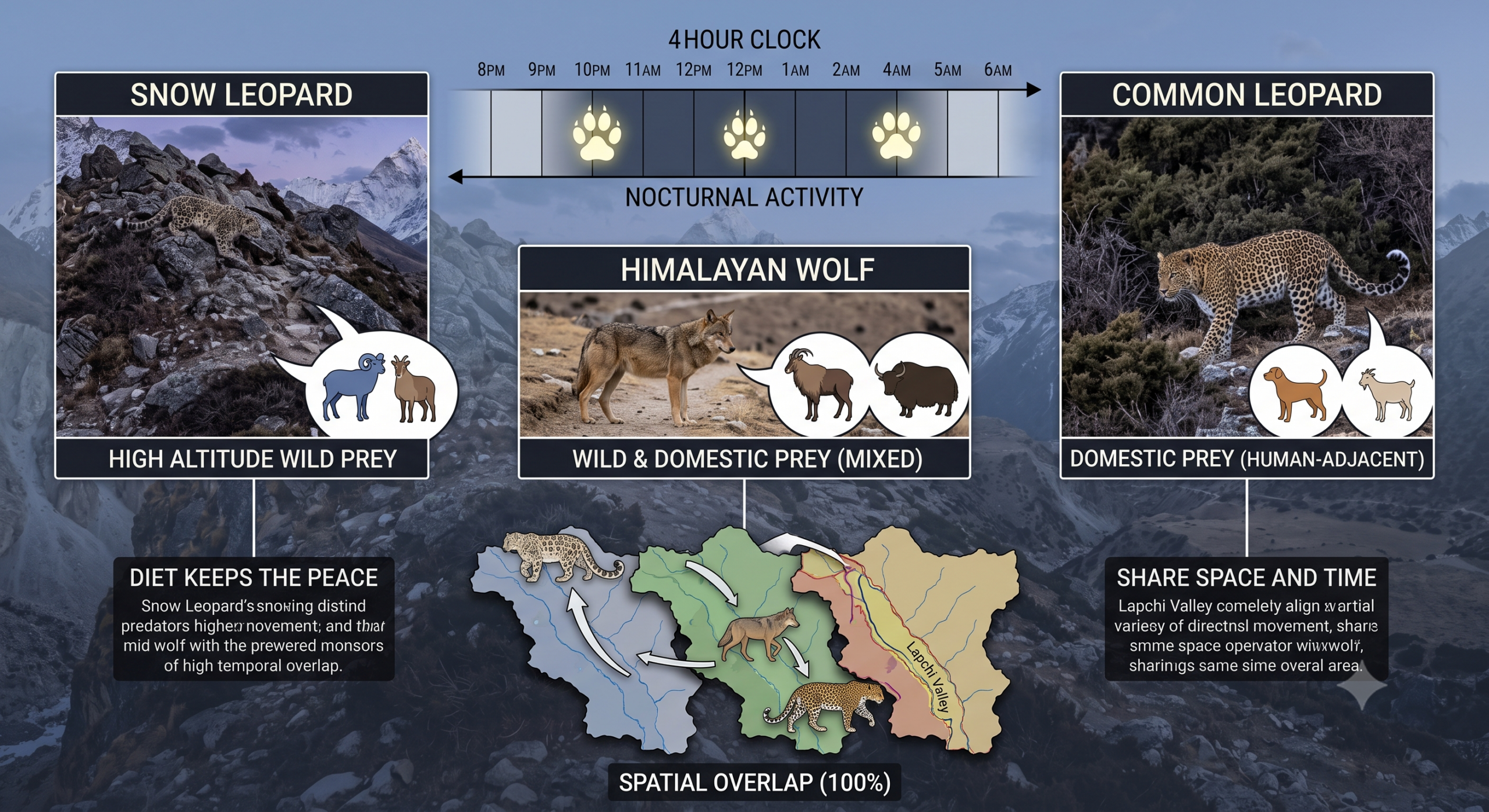
In the rugged, remote Lapchi Valley within Nepal’s Gaurishankar Conservation Area, three of Asia’s most formidable apex predators—the elusive snow leopard, the adaptable common leopard, and the fierce Himalayan wolf—are living right on top of each other. They use the exact same terrain and roam at the exact same hours of the night.
So, how do they avoid a bloody, non-stop turf war? The secret isn’t where or when they hunt—it’s what’s on the menu.
The Surprise of Overlapping Worlds

Led by researcher Narayan Prasad Koju from the Nepal Engineering College, scientists spent over six years gathering camera-trap data and meticulously analyzing fecal DNA and prey hair under microscopes. What they found surprised even the experts.
“The biggest surprise is that space and time are not what keep peace among the top three predators,” Koju told Mongabay. “The fact that diet alone is doing so much of the work while the animals are essentially sharing the same space at the same hours is an interesting finding.”
There is a massive spatial and temporal overlap. All three are predominantly nocturnal, wandering the pitch-black mountain passes at the same time. Yet, a delicate evolutionary strategy known as trophic niche partitioning allows them to stay out of each other’s hair by choosing completely different food profiles.
The Three Menus
By mapping out their diets, researchers unlocked the secret to this high-altitude harmony:
- The Snow Leopard (The Pure Wild Hunter): True to its title as the “ghost of the mountains,” the snow leopard strictly relies on wild alpine prey. Blue sheep make up nearly half of its diet, alongside musk deer, Himalayan tahr, and serow.
- The Common Leopard (The Human-Adjacent Opportunist): The common leopard takes a radically different route. They heavily rely on livestock and domestic animals associated with human settlements (including domestic dogs), supplemented by lower-altitude forest prey like barking deer and goral.
- The Himalayan Wolf (The Flexible Middleman): The wolf sits right in the middle. They have a substantial dietary overlap with snow leopards, hunting wild blue sheep and musk deer, but they balance it by also hunting livestock like goats, horses, and yaks.
Because the common leopard targets entirely different prey, it significantly reduces the overall friction in the ecosystem, keeping the competitive pressure manageable for the wolves and snow leopards.
A Delicate Balance Under Threat
While this “food truce” has worked for generations, scientists warn that climate change and human expansion are actively destabilizing the peace.
As global temperatures rise, treelines are shifting upward, shrinking the precious alpine zones that snow leopards rely on. In fact, experts like Madhu Chetri from the National Trust for Nature Conservation note that up to half of the current snow leopard habitat in the Himalayas could be altered by these shifting treelines.
As a result, common leopards are expanding further up into high-altitude territories. When habitats shrink and wild prey declines, all three predators are forced to pivot toward the same target: village livestock.
The Conservation Urgency
According to a recent government survey, Nepal is home to just an estimated 397 snow leopards, and both leopard species are listed as Vulnerable on the IUCN Red List.
Currently, in the remote Lapchi Valley, local herders graze their livestock out in the open with no containment or predator-proof corrals. When a leopard or wolf kills livestock, it triggers devastating retaliatory killings by locals. Interestingly, Koju points out a tragic twist: because snow leopards are the most famous and visible symbol of the region, herders often retaliate against them, even when a common leopard was the actual culprit.
To save all three species, Koju emphasizes that conservation priorities must shift immediately toward protecting wild prey populations and funding predator-proof corrals and compensation schemes for local herders.
The apex predators of the Lapchi Valley offer a striking lesson in ecological compromise. They prove that even in Earth’s harshest environments, coexistence is possible through specialized adaptation. However, as humans push further into the mountains and climate change reshapes the heights, it’s up to us to ensure that this delicate dinner diplomacy doesn’t collapse into conflict.
Source: https://journals.plos.org/plosone/article?id=10.1371/journal.pone.0344947
